A walk in the island of Crete is a scent of spring flowers growing in the yards of the houses. Generations of Minoans, Greek, Roman, Byzantine, Venetian, Turkish, Jewish and Egyptian people live there.
History is alive in Crete , breathing through bow strokes of the lira and the violin, the sound of the lute and bagpipe. Finally, it is the taste of the history of the eastern spices, unique herbs and greens, blessed oil and wine. Here, in this cultural crossroads a lot of memories are alive and a large number of elements of others cultures still from a part of the everydayness of the Cretan people.
Mythology - Antiquity
Cretan- born Zeus was born and raised in the mountains of Crete. Minos is referred to mythology as the son of Zeus and Europe, Minoan Crete, with its ninety cities and their brave young men are also mentioned by the Homer and Ilias.
There is evidence that the island was inhabited ever since the Neolithic times. During the Cooper Age the Minoan civilization developed, especially from 1900 BC until its sudden disappearance around 1500 BC.
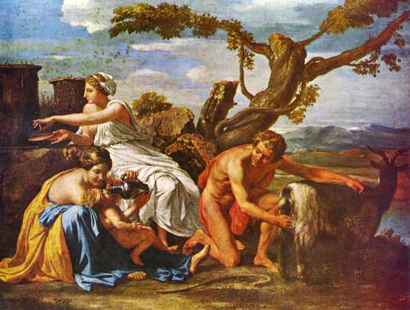
The birth of Deus in the mountains of Crete
History of Minoan civilization
The Minoan civilization was the Aegean Bronze Age civilization that arose on the island of Crete and flourished from approximately the 27 BC to the 15 BC century. It was rediscovered at the beginning of the 20th through the work of British archaeologist Arthur Evans, Will Durant referred to it as the “first link to the European chain”.
The early inhabitants of Crete settled as early as 128,000 BC, during the middle Paleolithic age. It is not until 5,000 BC that the first signs of advanced agriculture appeared, marking the beginning civilization. The Minoan culture was established by the 27 century BC.
The term Minoan was coined by Arthur Evans, after the mythic king Minos. Minos was associated in Greek myth with the Labyrinth, which Evans identified with the site at Knossos.
Minoan palaces (anaktora) are the best known buildings types to have been excavated on the island. There are monumental buildings serving administrative purposes, as evidenced by the large archives unearthed by archaeologists. Each of the palaces excavated today has its own unique features, but they also share features, which set them apart from other structures. The palaces were often multi-storied, with interior and exterior staircases, light wells, massive columns, storage magazines and courtyards.
Minoans were traders and their cultural contacts reached far beyond the island of Crete- to Egypt Old kingdom, to copper-bearing Cyprus, Canaan and the Levantine coasts beyond, and to Anatolia. In late 2009, Minoan- style frescoes and other Minoan- style artifacts were discovered during excavations of the Canaanite palace at Tel Kabri, Israel, leading archaeologists to conclude that the Minoan influence was the strongest foreign influence on that Canaanite city state. These are the only Minoan remains ever found in Israel.
Minoan techniques and styles in ceramics also provided models, of fluctuating influence of Helladic Greece. Along with the familiar example of Thira, Minoan “colonies” can be found first at Kastri on Cythera, an island close to the Greek mainland that came under Minoan influence in the mid-third millennium (EMII) and remained Minoan culture for a thousand years, until Mycenaean occupation in the 13th century. The uses of term “colony», however like “thalassocracy” has been criticized in recent years. The Minoan strata there replace a mainland- derived culture in the Early Bronze Age, the earliest Minoan settlement outside Crete.
The Cyclades were in the Minoan cultural orbit, and, closer to Crete the islands of Karpathos and Kasos also contained Minoan colonies, or settlements of Minoan traders, from the middle Bronze Age (MMI-II). Most of them were abandoned in LMI, but Minoan Karpathos were recovered and continued with a Minoan culture until the end of the Bronze Age. There was a Minoan colony at lalysos on Rhodes.
Minoan cultural influence indicates an orbit that extended not only throughout the Cyclades, but in locations such as Egypt and Cyprus. Paintings for the 15th century BC in Thebes, Egypt depict a number of individuals, who are Minoan at appearance, bearing gifts. Inscriptions record these people as coming from Keftiou, or “the island in the midst of the sea” and may refer to gift-bringing merchants or officials from Crete.
Certain locations within Crete emphasize it as an “outward looking” society. The Neopalatial site of Kato Zakros, for instance, is located within 100 meters of the modern shoreline, situated within a bay. Its large number of workshops and the richness of its site materials indicate a potential “entreport” for import and export. Such activities are elaborated in artistic representations of the sea, including the Flotilla fresco from room 5, in the west house at Akrotiri.
Historians and archeologists have suggested that the Minoans were involved in the Bronze Age’s important tin trade: tin, alloyed with copper apparently from Cyprus, was used to make bronze. The decline of Minoan civilization and the decline in use of bronze tools in favor of iron ones seem to be correlated.
Hellenistic era to Byzantium
Then Greek tribes, the Dorians and the Achaens, arrived at the island, followed by the Romans in 67 BC and then the Byzantines, with an interval between 824- 961 AD, when the island into the arms Arab pirates. In 1204 Crete was conquered by the Venetians, who were ousted by the Turks in 1669. From the Venetian period a lot of important buildings, like castles, mansions and fortifications have survived to the present day, not only in the well-known towns and harbors of Chania, Rethymnon and Heraklion, but also in every corner of the island. After the fall of Constantinople many scholars and artists of the Byzantium took refuge in Crete. So letters and arts flourished on the island, in a period critical to the maintenance of the Greek culture.
Ottoman occupation
Following struggles of almost two centuries the Ottomans conquered the island in 1669. The Cretans strongly resisted the Ottoman invaders paying a bloody death tool of their love of freedom. Uncountable revolutions set the island on fire. One of the first revolts was the revolt of 1770, led by Daskalogiannis from Sfakia, who died a martyric death at the hands of Ottomans. In 1822 the Ottoman invaders had to ask the Egyptians for help, in order to suppress the revolt. As a result, Crete were under the rule of the Egyptians in 1831.
19th -20th century
At the end of 19th century the Ottoman troops left the island, which was autonomous until its Union with Greece in 1913. The politician Eleupherios Venizelos played an important role in the Union of Crete.
Crete strongly resisted the German invaders as well. The battle of Crete constitutes a brilliant page in world history, as simple citizens, elderly people and children resisted the heavily armed invaders. The Cretans paid their bravery with executions, tortures and destructions of entire villages by Nazi regime.
The music of Crete is a traditional form of Greek folk music, also called Kritika. Although, the Lyra is the dominant instrument for the genre, it is often accompanied by the Mandolin, the Askomandoura, and the Laouto.
Crete has its own distinctive Mantinades poetry. The island is known for its Mantinades- based music (typically performed with the Cretan Lyra and Laouto) and has many indigenous dances, the most noted of which are the Pentozali, Sousta, Chaniotis etc.
Cretan authors have made important contributions to Greek Literature throughout the modern period. Major names are Vikentios Kornaros, who created Erokritos, an epic romance (17th century) and in the 20th century Nikos Kazantzakis. In the renaissance, Crete was the home of the Cretan School of icon painting, which influenced El Greco and through him the subsequent European painting.
Cretan are fairly proud of their island and customs, and men often don elements of traditional dress in everyday life: knee- high black riding boots (called stivania), vraka breeches, tucked into the boots at the knee, black shirt and black headdress consisting of fishnet- weave kerchief worn wrapped around the head or draped on the shoulders (the sariki). Men often grow large moustaches as a mark of masculinity.
Hiring a car is easy, as long as you have your driving license with you. Check, though, that the insurance is comprehensive and make sure when you take the car that all the pervious marks on it are recorded so that you don’t get charged for these! Insurance on hire cars does not usually cover the underside of the car, or damage to tires. Gas stations often close around 9PM, particularly in villages. Most gas stations expect you to pay cash- they serve you, so you can choose for them to fill the tank or put in gas to a cash value. On the national highway, there are service stations, but there are often 30 miles or so apart- make sure you fill up with gas before bank holidays and Sundays when you may have more difficulty finding an open station. Taxi services are another way to get around Crete, but can be quite expensive, however, very accessible and you will find taxi stands in the center virtually all villages, towns and cities. Creek taxis all work under the Greek state and the taxi driver must always charge by the meter prince, which he must turn on as soon as you get into the cab. Taxi drivers are perhaps the most aggressive of the drivers on the island. There are two taxi tariffs in Greece: Tariff 1 is day hours from 5.00am to midnight and Tariff 2 is night hours ranging from midnight to 5.00am.
Most major road signs are in both English and Greek. Usually the Greek sign is first, followed by an English sign.
By bus
Public transportation is fairly frequent and timetables quite trustworthy. Bus drivers usually divert from their marked routes to enter little villages if asked to do so. Bus services along the north coast and towards the south coast are excellent, reliable, frequent and cheap.
By ferry
Crete has many ferry connections. For example, you can go from Piraeus to Heraklion with Minoan Lines, to Chania with Anek Lines or Hellenic Seaways, to Agios Nikolaos an Sitia with Lane Lines. Lane also operates routes from Agios Nikolaos, Sitia to Rhodes and other Creek island. In the summer there are daily catamarans (hydrofoils) from Heraklion to Santorini. The trip takes about 2.5 hours. Hellenik Seaways and Seajets offer these sailings. You can also go to Crete by ferry from the Peloponnese (Gytheio) and Kithira island. The ferry lands on the west part of Crete, Kissamos port.
The main ports in Greece that ferries come into are in Heraklion, Chania, Rethymnon, Sitia and Kastelli-Kissamos . Since there no roads along the southwest coast there is a ferry line with connections between Paleochora, Sougia, Agia Roumeli, Loutro and Chora Sfakion (Sfakia). There is also a connection with inject of Gandos, the southernmost point of Europe (Cape Tripiti).