The prefecture of Rethymnon is in the heart of Crete and it’s one of the most beautiful places in Greece. Rethymnon awaits you with clear blue seas and mountains Psiloritis, there are traces of a civilization that dates back 4,500 years, numerous Byzantine churches and monasteries, enchanting Venetian monuments, the most well-preserved Renaissance city in Creece, with endless beaches, caves, gorges and unique flora and fauna.
Rethymnon is a city of approximately 40,000 people, the capital of Rethymno regional unit on the island of Crete. It was built an antiquity but was never a competitive Minoan center. It was however strong enough to mint its own coins and maintain urban growth. One of these coins is today depicted as the crest of the town with two dolphins in a circle.
A poet says about Rethymnon: Rethymno is not a place where you go to, but a place where you return. The words of this poet are confirmed by the great number of visitors, who return repeatedly. Along with this, Rethymnon is the homeland of Zeus, the god of hospitality.
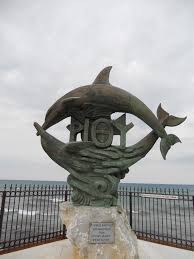
the crest of the town
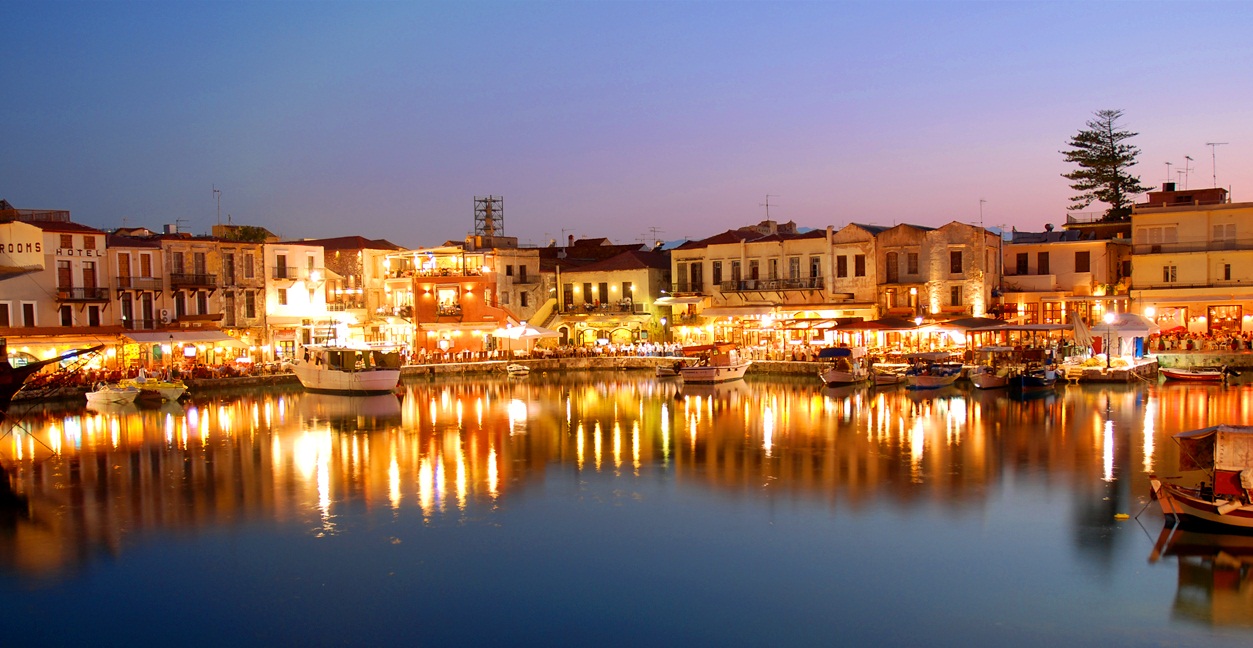
The port of Old Town at night
The existence of human life during the Neolithic Period (6000-2600 BC) is proved by archaeological findings in the Ideon Andron cave on mountain Psiloritis, the Gerani cave west of Rethymno and the Elenon cave in the Amari district.
The great number of archaeological findings dating back to the Minoan period (2600-1100 BC) can be explained by the fact that human existence and activity became more common both in caves as well as in a variety of other dwelling places, the remains of which cover the entire area of the prefecture and are evidence of every stage of the Minoan period. Dating back to the Early Minoan Period (2600-2000 BC) in the Mylopotamos area are the Sfentoni cave in Zogiania and Pyrgi, Eletherna, in the Municipality of Rethymnon are the cities of Chamelevri, and Apothoulou in the Amari district.
The palatial installations on Monastiraki in the district in the district of the Amari, the settlements of Pera Gallinous in the Mylopotamous area, and Stavromenou as well as the caves of Melidoni and Patsos in the Municipality of Rethymnon date back to the middle-Minoan period. Finally, the cemetery of Armeni, the settlement of Zominthos in Anoghia and the place of worship on Fantaxospiliara in the village of Prinos date from the late Minoan Period (1600-1100 BC).
During the First Byzantine period (330-824) when the capital of the Roman Empire was transferred to the Byzantium and Constantinople was founded in 330, Crete was included in the East Roman Empire, constituting a separate district, which was governed by a Byzantine general. Henceforth Christianity expanded on the island, and in the 8th century the Cretan Episcopate was integrated with the Patriarchate of Constantinople. During the early Christian and First Byzantine period a large number of temples were built, archaeologists have discovered many of which.
Starting from the year 824 up until 961, the island was governed by the Arabs, although very little evidence of this fact was found in the area of Rethymno apart from some Arabian coins, which were found in the village of Giannoudi.
During the Second Byzantine period (961-1210) fortification works of the town of Rethymno were started for the first time as we shall see further on. In the year 1211 the long and interesting period of the Venetian occupation began, remains of which can clearly be seen still on all levels in the area of the town of Rethymno.
Crete's liberation by Nikiforos Foka in 961, followed by its re-integration into the Byzantine Empire, signaled the beginning of the Second Byzantine Period, which lasted up until the arrival of the Venetians on the island in 1204. At that stage a fortified wall was built around all the buildings, thus constituting the first fortified settlement, the so-called "Castrum Rethemi", which the Venetians later called Castel Vecchio.
The period of the Venetian occupation formally began in 1204, when Crete was passed over to Bonifatius of Montferrato, who later handed it over to the Venetians. However, in 1206 the Genoese pirate Enrico Pescatore invaded the island, and it was not until as late as 1210 that the Venetians actually succeeded in regaining control of Crete again. The Cretans were in opposition to their conquerors, which resulted in a series of revolutions during the period between 1211 and 1367.
Despite the Cretan resistance, the Venetians embarked on successive administrative changes, according to which the island was initially divided into six, and later, during the 14th century, into four sections, with the capitals Chania, Rethymno, Chandakas and Sitia. The Duke (Duca), who had his seat in Chandakas, had sovereign power over the entire island.
Rectors (Rettore), who were supported by two Councillors (Consiglieri), were in administrative command of the districts of Chania, Rethymno and Sitia.
After the fall of Constantinople in 1453 the position of the Venetians in the East was gradually weakened.
As early as in 1537/38, the architect Michele Sanmicheli from Verona was entrusted with a programme of fortification works, which had already been initiated by the town of Rethymno. His drafts included the land wall of the town, on which the construction works were started in 1540 and completed in 1570.
Chaireddin Barbarossa looted the village of Apokorona, the surrounding villages of Chania, and the towns of Rethymno and Sitia. The attack of the pirate Ulutz-Ali on 7 July in 1571 devastated Rethymno. The Turks found the town deserted, whereupon they plundered it and set it on fire.
Most of the houses were burnt; the walls of the Castel Vecchio as well as the land wall, which had only been completed a short time before, had vanished. As a result of these events it was decided to build a fortress on the hill of Palaiokastro, the walls of which should also protect the houses of the town. In 1573, the foundation works of the fortress were realised under the leadership of the Rector Alvise Lando. The architect Sforza Pallavicini drew the initial plans, whilst the supervising mechanical engineer was Gian Paolo Ferrari.
After the fortress had been completed they realised that the space was actually too small to house all the buildings. Consequently it was decided that only the Venetian administration, the Latin Episcopate and the Military authorities should be accommodated within the fortress, while it should merely serve as a place of shelter for the inhabitants in case of emergency.
After several years, when the fortress, the so-called Fortezza, was completed, the Venetians had secured a powerful position on the island. Thus, towards the end of the 16th century the city achieved characteristics of the Renaissance according to Venetian examples.
This stage included the construction of luxurious public and private mansions, while at the same time the city achieved a central square (piazza) as did the city of Venice, a club house of the nobility (Loggia), fountains such as the Rimondi fountain, a large sundial, a central street, as well as smaller by-passing roads, which led to the temples, the monasteries, the mansions and the simple houses. Those magnificent buildings were ornamented with a variety of doorframes, some of which were kept simple, whereas others were greatly decorated.
hey have been preserved up until today and give evidence of that brilliant stage in history of the city of Rethymno. During that atmosphere of Renaissance, in which the Hellenic element definitely excelled, the union of two civilisations was accomplished, which influenced the intellectual and artistic domain to a large degree. Scholars such as Markos Mousouros, Zacharias Kalliergis and the brothers Vergikios were highly esteemed in Europe, whilst G. Hortatzis, Troilos and Marinos Tzane Bounialis, the poet of the Cretan War, contributed to the flourishing Cretan literature and were rewarded for their achievements.
On a similar line, Emmanuel Lambardos and Emmanuel Bounialis, both of who were worthy representatives of the so-called Cretan School, also expressed the era of Renaissance in the art of painting.
In 1645 the first Turkish troops landed at Chania and besieged the city immediately. After two months the city surrendered and the great Venetian-Turkish Wars of the 17th century had started.
On 29 September 1646 the troops of Hussein Pasha arrived at the fortified walls of the city of Rethymno. These walls had already been weakened because of the many earlier raids led by the Turks, who had previously established themselves in the area of Chania.
Citizens and civilians gathered inside the fortress, where the situation had reached dramatic dimensions due to the plague, the injured, the lack of food and most importantly the lack of ammunition.
When the Governor realised that the town could no longer be defended, he raised the white flag and negotiated the capitulation of the city of Rethymno - fortunately on favourable conditions: any of the inhabitants who wished to go to Chandakas were transferred there, while those who wished to stay became subjects of the Sultan.
The Fortezza of Rethymno was surrendered to the Turks on 13 November 1646.
The domination of the Turks over the inhabitants of Rethymno (1669-1898) as well as over the rest of Crete, brought many important changes not only in the administrative, economic and population areas, but also in the intellectual and every-day life of the people. By that time the island of Crete was considered large enough to initially be divided into three regions, that of Chandakas, of Rethymno and of Chania, to which that of Lassithi was added later. None of these regions were governed by a Pasha. The image of the town changed radically.
The conquerors installed themselves in the Venetian mansions, which they decorated with their own architectural elements. At the same time they started building mosques and minarets, which further emphasised their presence. The so-called "sachnisia", wooden balconies projecting from the façade of the buildings, suddenly appeared in the former Venetian alleys and network of streets, thus giving the city a new character - that of a Moslem town.
Many churches were destroyed; others were turned into mosques. As could be expected, these acts led to an intellectual decline. The period of the "Cretan Renaissance" with its flourishing literature and fine arts belonged to the past. Christians were slaughtered and their properties plundered, which resulted in a series of uprisings and revolutions started by the Cretans, among which the most important took place in 1821 in the framework of the general uprising of the Greek people against the Turkish subjugators.
However, the Cretans did not succeed in obtaining their freedom in the revolution of 1821. Instead the island was assigned to the Egyptian Vice-Roy Mechmet Ali (1830-1841), a fact, which gave only small relief for the Christian inhabitants of the island, who continued to fight for their freedom. Over the years their continuous struggles showed a few results with regard to privileges concerning the freedom of religion and the right of holding property.
However, the Cretans were not satisfied unless they were completely liberated and united with the Greek mainland. A crucial battle was fought during the Great Cretan Revolution, which lasted for three years, from 1866 to 1869, and during which the holocaust of the Arkadi Monastery took place. Even after this shattering event and their crucial battle for freedom, the Cretans continued to be dominated by the Turks with no change to their situation. Therefore, another revolution followed, that of 1878, and as a result of this one they achieved several religious and political privileges, the most important of them being that a Cretan was allowed to be the General Governor of Crete.
However, this did not mean that the situation improved henceforth. On the contrary, from 1890 to 1895 the Turks showed an even more merciless attitude towards the locals, which resulted in the revolution of 1897, and due to this revolution the Cretans finally secured their autonomy
Archaeological Museum of Rethymno:
The Archaeological Museum of Rethymno was founded in 1887 by the Society of the Friends of Education. Today it is housed in the pentagonal bastion in front of the central, east gate of the Fortezza. This building represents one of the fortified construction works accomplished by the Turks, who chose this location in order to defend the central entrance to the fortress. The archaeological findings are exhibited in the Museum in archaeological order and include the following collections:
1.Late Neolithic and Proto-Minoan findings, mainly vessels, tools and figurines from the Gerani and Melidoni caves.
2.Objects of the Middle-Minoan period found at the archaeological sites of Monasteraki, Apodoulou and Vryssina. Most interesting in this unit are the collection of seals from Monasteraki and the replica of a settlement from the same area.
3.Findings of the Late Minoan period mainly from the cemetery of Armeni, but also from other areas such as Mastabas, Stavromenos, Pangalochori and Syvritos. The objects include bronze tools and weapons, an impressive serrated helmet, a large variety of ceramics, jewellery and cameos, as well as earthenware figurines, one of which depicts the famous goddess with raised hands from Pangalochori. Furthermore, the earthenware urns with floral and geometrical ornaments, mainly finds from the cemetery of Armeni, are also interesting.
4.Findings of the Geometrical - Archaic Period mainly from the archaeological sites of Axos and Eleftherna.
5.Objects from the Classical, Hellenistic and Roman Period, mainly from the areas of Stavromenos and Argyroupolis. This unit boasts Roman oil lamps with various depictions, gold jewellery from the area of Stavromenos and glass vessels from the Hellenistic and Roman period.
6.Collection of coins.
7.Figurines from Melidoni and Axos as well as pots of unknown origin from the Classical and Hellenistic period.
8.Inscriptions from the area of Eleftherna.
9.Collection of sculptures from the areas of Stavromenos, Eleftherna and Argyroupolis.
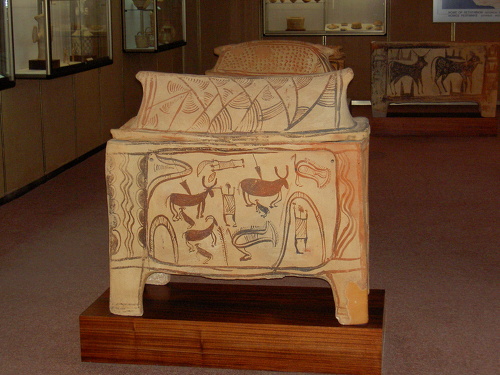
One of the exhibits at the archaeological museum
Address: Opposite the main gate of the Fortetsa.
Operation Hours:
Monday: Closed,
Tuesday-Sunday: 08.30-15.00
Tickets:
Full admission: € 3
Reduced admission: € 2
Telephone: +30 28310-54668
E-mail: keepka@culture.gr
Museum of Contemporary Art of Crete - Municipal Gallery "L.Kanakakis":
Τhe Municipal Gallery "L. Kanakakis" was founded in 1992. From its beginning it was housed in a Venetian building in the heart of the old, historical town of Rethymno, below the Fortezza and the Archaeological Museum.
It houses a permanent exhibition of the work of Lefteris Kanakakis (oil paintings, sketches and aquarelles), thus representing all the stages of his achievements, as well as works of contemporary Greek artists, which cover a broad spectrum of modern Greek art as it has been accomplished from 1950 until today.
In 1995, the town of Rethymno was incorporated into the National Cultural Network and, as a result, the Centre of Contemporary Art was established, which then proceeded to influence the course of activities of the Gallery with respect to modern art. The Centre of Contemporary Art of Rethymno is initiating dynamic activities in the field of periodic exhibitions of local, national and international interest in co-operation with many supporters both Greek and foreign. All events are carried out within the framework of parallel activities such as lectures, educational programmes, speeches, seminars etc.
On a similar line the Centre of Contemporary Art- Municipal Gallery "L. Kanakakis" complements its activities with the edition of catalogues and other educational or instructive material. Furthermore, since 1995 art workshops have been operating under the direction of the Centre of Contemporary Art.
Address: 5, Chimaras Street
Operation Hours:
1 April - 31 October:
Monday closed
Tuesday - Friday
09:00 -13:00 & 19:00 - 22:00,
Saturday and Sunday
10:00 - 15:00.
1 November - 31 March:
Monday closed
Tuesday - Friday 09:00 - 14:00,
Wednesday & Friday 09:00 - 14:00 & 18:00 - 21:00
Saturday - Sunday 10:00 - 15:00.
Tickets: Full admission: € 3,00, Reduced admission: € 1,50
Telephone +30 28310 52530
+30 28310 52689 (and fax)
Webpage: www.cca.gr
E-mail: info@cca.gr
Historical and Folklore Museum:
The Historical and Folklore Museum of Rethymno was founded in 1973 with the aim of collecting and starting research on folklore material from the area of Rethymno. Since 1995 it has been housed in a listed urban Venetian building dating back to the 17th century and situated at 28-30 Vernardou Street.
The two-storey building with its interior yard presents a variety of particularly interesting architectural details. The collections in the Museum come from donations and purchases and include among others hand-woven textiles, tools for the art of weaving, embroideries, lacework, ceramics, baskets, items of metalwork, coins, costumes and historical relics.
One of the rooms is dedicated to traditional farming and the traditional way of preparing bread in Rethymno, while in another room traditional professions are referred to. The artefacts are exhibited in units and are equipped with explanatory labels in both Greek and English, photographs and drafts according to the demands of a modern museum management.
Address: Manouil Vernadou 28-30
Operation Hours: April - 25 October: Monday - Saturday 10:00 – 14.15.
26 October – March: every Wednesday 10:00 – 14.15 and other days after request.
Tickets:
Full admission:€4,
Reduced admission: € 2
Telephone +30 28310 23398
Fax +30 2831023667
The Museum of "Monastery of Preveli":
Preveli Monastery, located just 37 km from Rethymnon consists of two monasteries:
The Lower Monastery (Monastery of Agios Ioannis Prodromos, or Saint John the Baptist), now abandoned, is a typical example of simple, everyday architecture.
The Rear Monastery (Monastery of Agios Ioannis Theologos) is a large group of buildings with a wonderful view over the Libyan Sea and has numerous relics which are exhibited in the monastery’s ecclesiastical museum.
Many of the rescued relics and images are displayed in the stylish museum inside the monastery. Saved a significant number of icons (about 100) from the occasional ornaments of the Catholic, the various Catholic churches and the Baptist.
The collections of the Monastery of Preveli include:
a) Collection of images.
b) Collection of vestments.
c) Collection of ecclesiastical vessels.
d) Collection of relics.
ADDRESS: Preveli.
HOURS: Daily 09:00 a.m. to 18:00 p.m.
ENTRANCE: 2, 50 €.
TELEPHONE: +30 28320 41 444.
The Museum of "Monastery of Arkadi":
The monastery of Arkadi is an Eastern Orthodox monastery, situated on a fertile plateau 23 km to the southeast of Rethymnon.
The monastery played an active role in the Cretan resistance of Ottoman rule during the Cretan revolt in 1866. 943 Greeks, mostly women and children, sought refuge in the monastery. After three days of battle and under orders from the hegumen (abbot) of the monastery, the Cretans blew up barrels of gunpowder, choosing to sacrifice themselves rather than surrender.
Today the monastery also houses a museum (in the southern wing) that has artefacts from the famous battle, church articles, and an absorbing picture gallery of the Cretans of that time.
Its collection consists of post-Byzantine icons, ecclesiastical vestments and implements, weapons, manuscripts, personal objects that belonged to the Abbot Gavriil and other religious and historic relics.
In a place of honour is the banner from the Arkadi holocaust, which depicts the Transfiguration of Christ . Another unique exhibit is the section of the carved altar screen of the church depicting the Resurrection, the only piece that survived the explosion and fire.
Examples of sacerdotal vestments, produced by the important embroidery centre at the monastery during the 17th century, are also displayed. A particularly outstanding piece with gold embroidery, dates to 1681 and depicts Christ and the twelve disciples.
Finally, among the weapons used during the struggle, including flintlock rifles, long-barreled pistols and pistols, there are Ottoman firearms such as the Turkish musket, as well as weapons that were given the surnames of benefactors acting on the rebel’s behalf aroad, such as Rodokanakis and Bernadakis, who sent them in aid of their beleaguered countrymen.
Address: Arkadi, 23 km to the southeast of Rethymnon.
Operation Hours: Daily 09:00 a.m. to 18:00 p.m.
Tickets: Full admission: € 2.50.
| Telphone: |
| +30 28310 83076 |
| +30 28310 83135 |
| +30 28310 83136 |
Fax: +30 28310 83137
Webpage: www.arkadimonastery.gr
E-mail: info@arkadimonastery
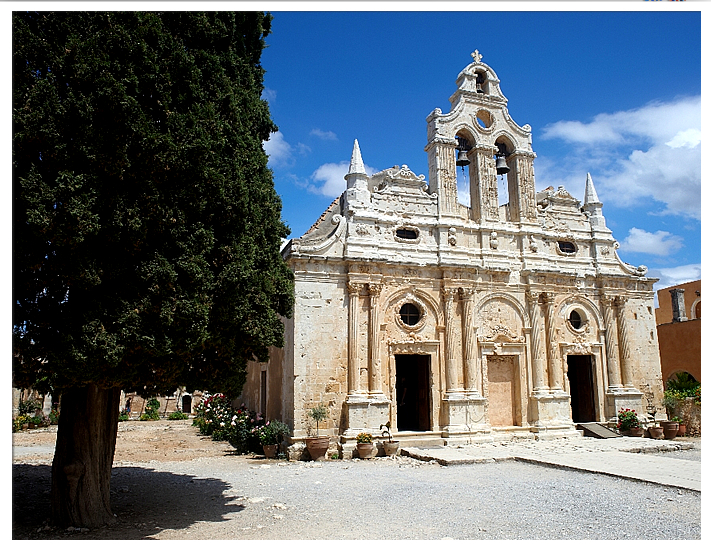
Arkadi Monastery
Rethymnon is ideal for summer holidays since it boasts a large number of beautiful and clean beaches. Magnificent Sandy beaches can be visited on the north coast, at the Cretan Sea as well as on the north coast of the island, at the Libyan Sea.
Rethymnon beach: Organized sandy beach more than 20 km long , stretching from the town of Rethymnon is an easterly direction towards the areas of Perivolia, Platanes Adelianos Kampos, Skaleta.
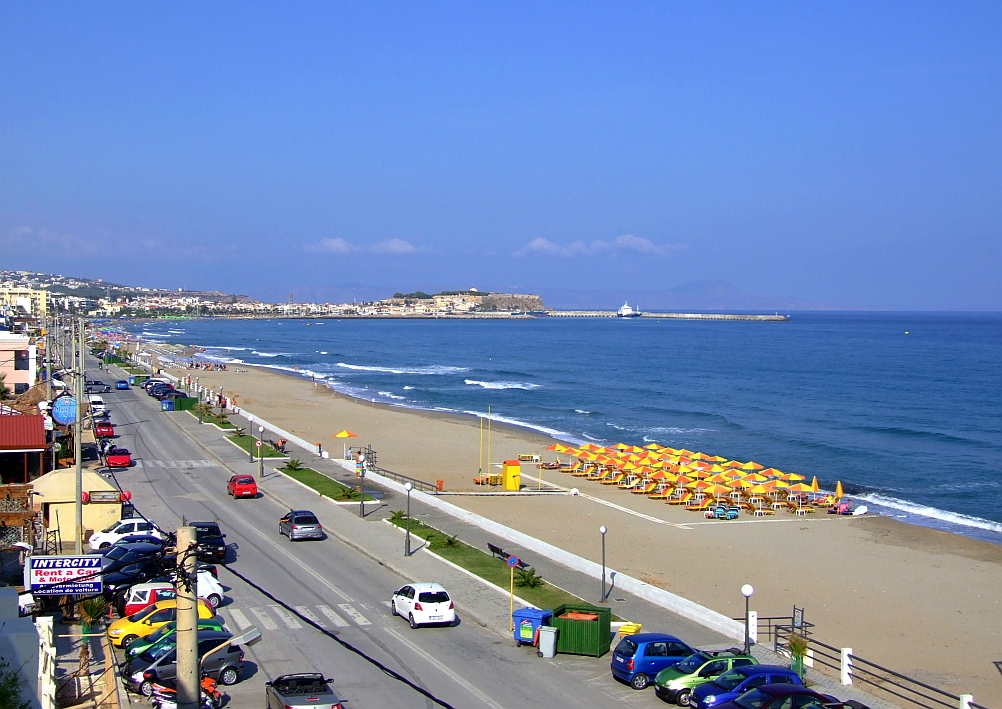
Rethymnon beach
Episkopi beach: Large sandy beach west of Rethymnon, partly organized.
Panormo: The coastal village is situated 20 km east of Rethymnon. It boasts an organized beach as well as a variety of taverns, hotels and rooms right by the sea.
Bali: Nestling in the surrounding mountains of the bay of Bali you will find the coastal village of the same name 34 km east of Rethymno. Visitors may choose from which of the small inlets to enjoy bathing at organized beaches. The area offer a large number of tavernas, hotels and rooms.
Plakias: The village of Plakias of situated 40 km south of Rethymnon. This resort boasts a superb sandy beach and the well-organized infrastructure includes hotels, rooms, taverns and restaurants. The organized beach offers both bathing and various water sports.
Souda Plakias: Organized, sandy beach west of the village of Plakias. A few tavernas are situated closed to the beach, where rooms are also available.
Damnoni: Organized, sandy beach west of the village of Plakias and south of the town of Rethymnon. It offers a few taverns and rooms are also available.
.jpg)
Damnioni beach
Ammoudi: Small sandy beach near Damnioni, not organized and fairly isolated. Preveli Lagoon: 38 km south of Rethymno, shortly before you arrive at the historic Monastery of Preveli, a track on the left hand side leads downhill to a parking place. After approximately 15 minutes downhill walk you arrive at the beautiful sandy beach with palm trees, where the river Kourtaliotis empties into the sea.
Lagoon of Preveli: At the point where the river Megalos Potamos empties into the sea and the goges of Kouratliotis ends are the famous Lagoon of Preveli and the beach of Finikas. In order to get there you follow the road to the Monastery of Preveli. Shortly before the Monastery a track on the left-hand-side leads down to a parking place. From the point on you will have to walk down to the sandy beach, where a remarkable, almost tropical landscape with numerous palm trees makes up for inconveniences. The river which flows into the sea, combined with the natural vegetation represents a magnificent sight that you sould not miss.
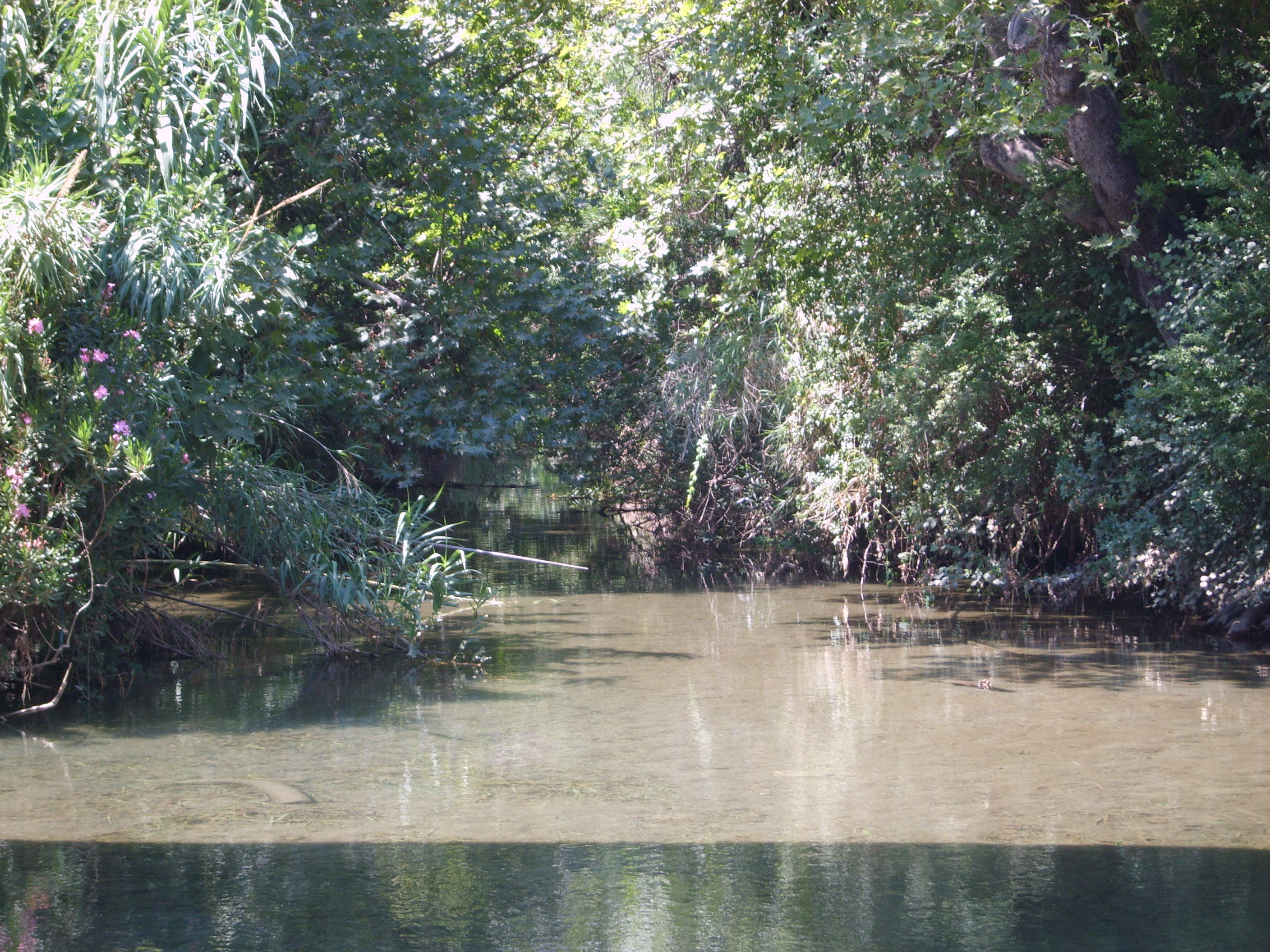
Detail of the Lagoon of Preveli
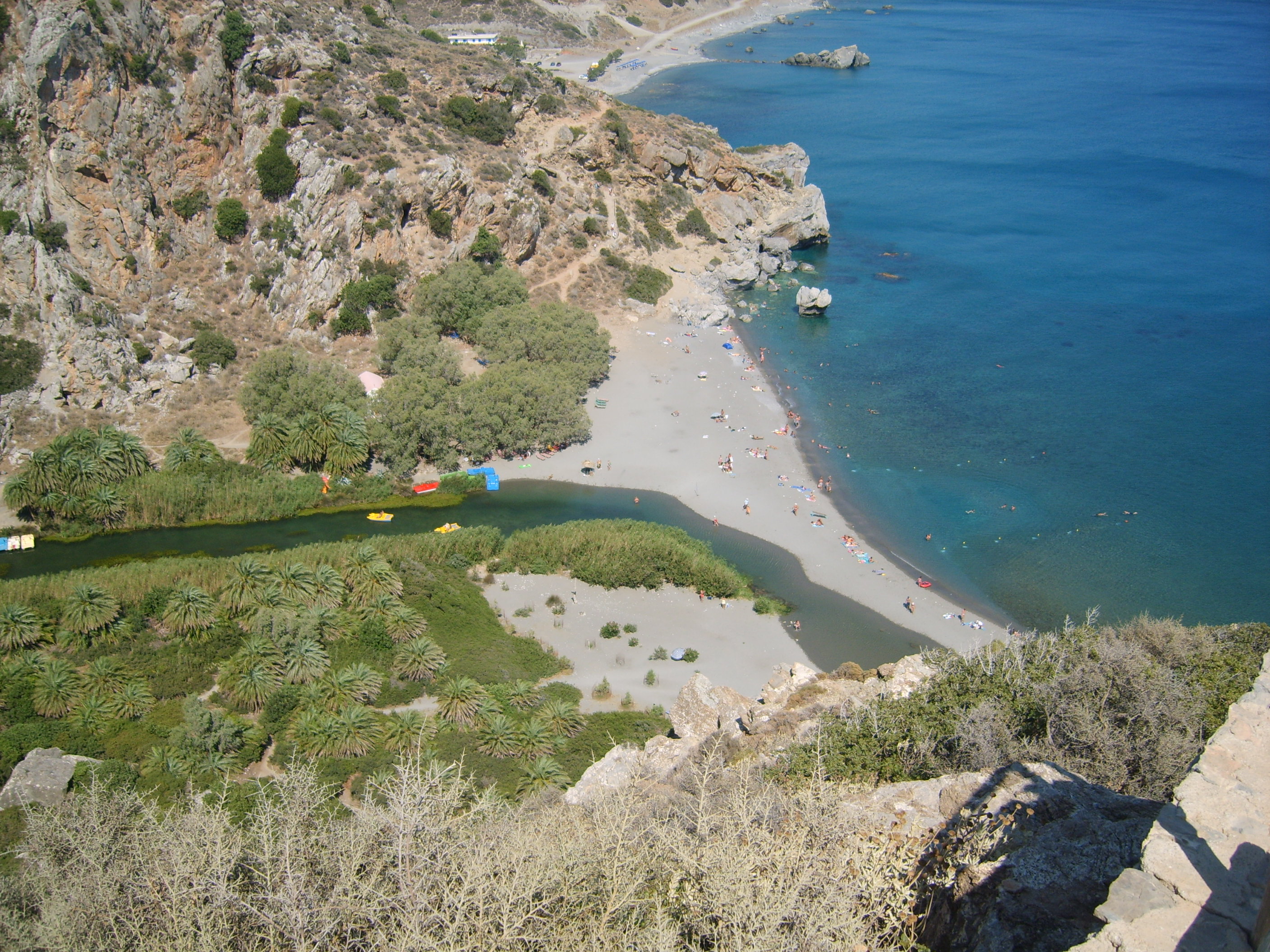
The beach from high above
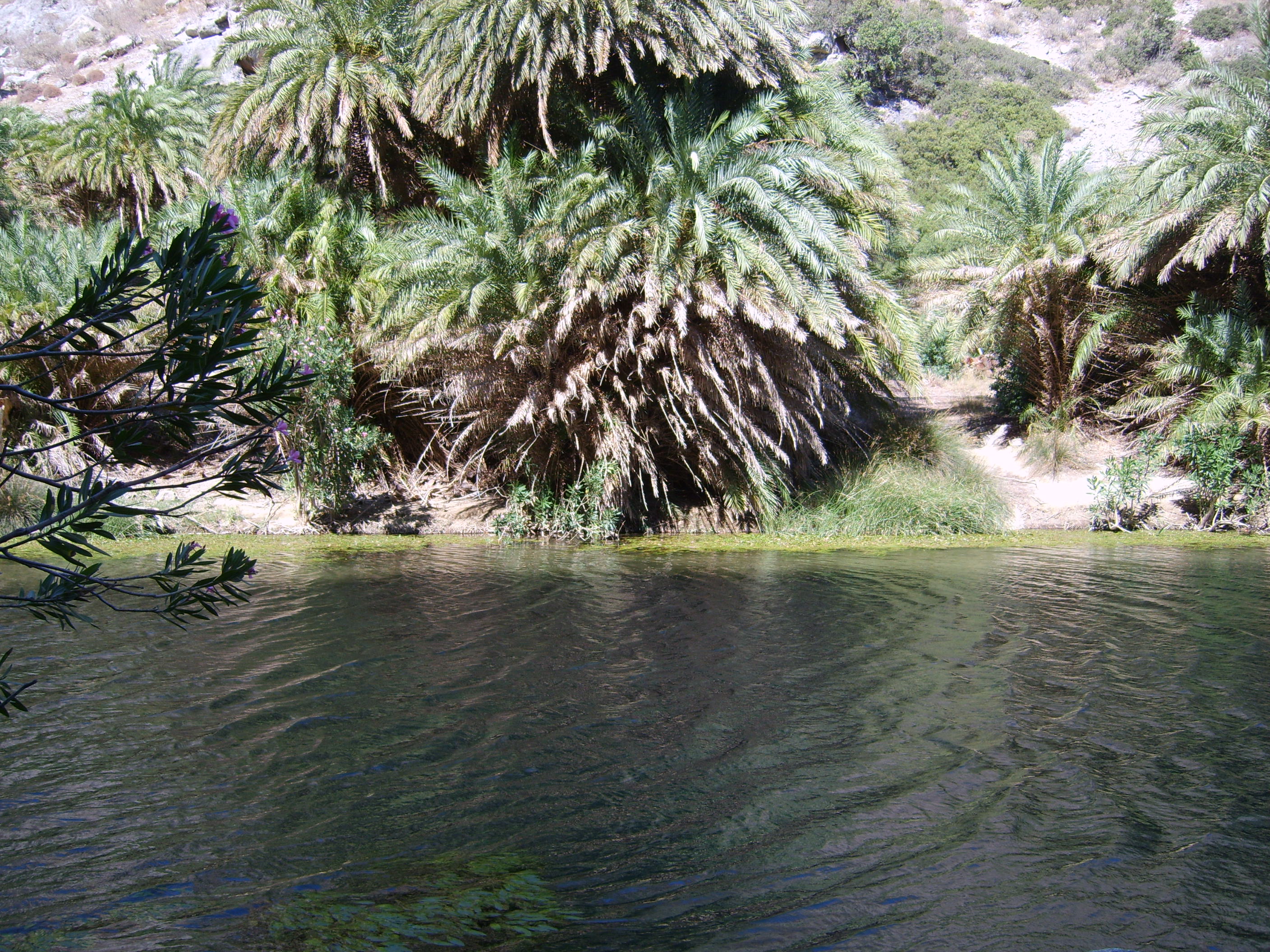
An incredible tropical environment


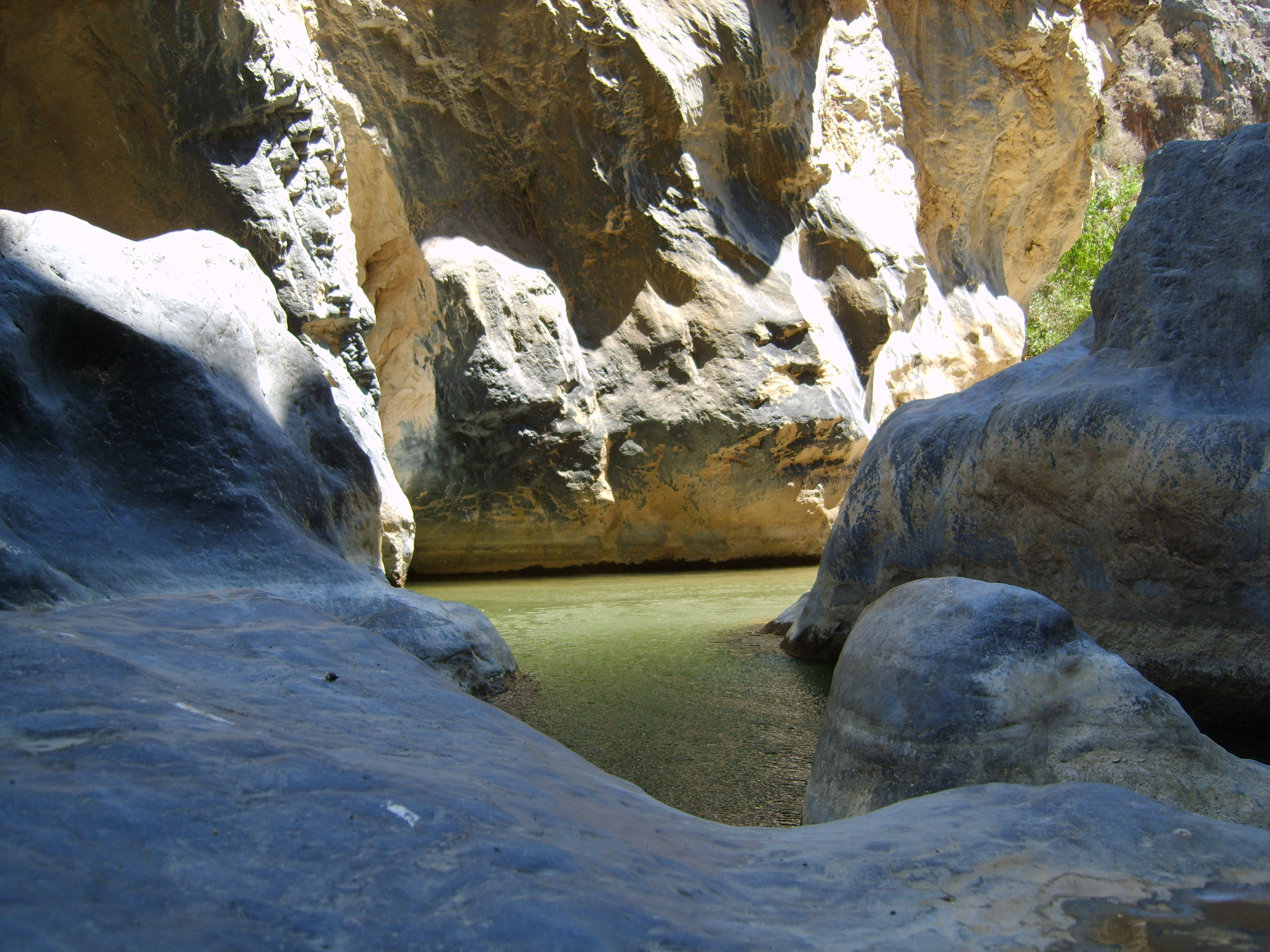
Discovering the river
Triopetra: The beach of Triopetra, which was named after the three distinctive rocks in the sea, is situated approximately 50 km south of Rethymnon. Follow the road ot Agia Galini and turn left after 40 km in the direction of Akoumia. Continue until you arrive at the huge sandy beach, which is not organized and fairly isolated.
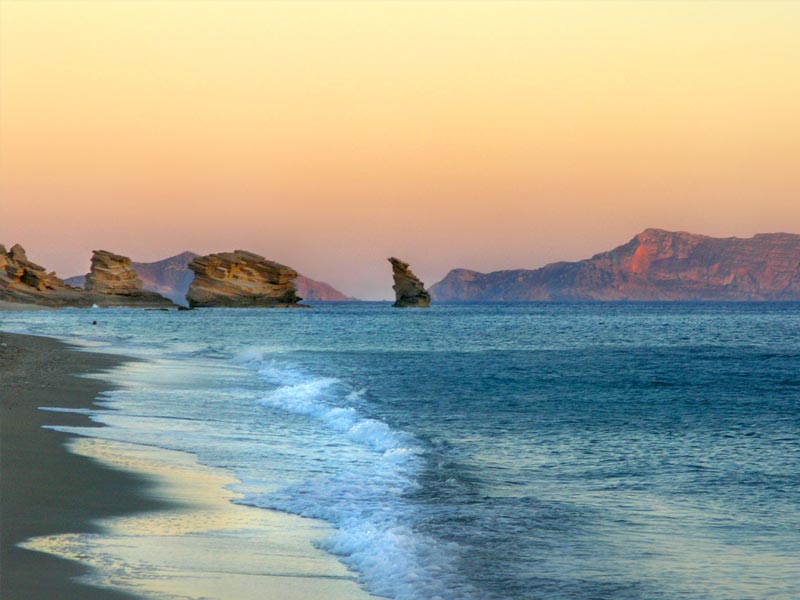
Triopetra
Aghios Pavlos: The magnificent sandy beach of Aghios Pavlos is found 58 km south of Rethymnon. Follow the road to Agia Galini and after 46 km turn right at the crossroads of the village of Kria Vrisi. Continue until you arrive at the seaside. Bathing is one of the isolated inlets, which have formed between the rocks, and seeing the sand dunes will be an unforgettable experience. In the village of the same name you will find rooms and taverns.
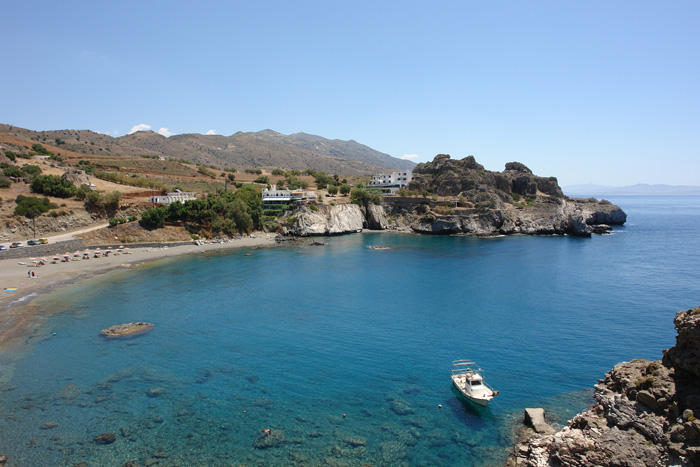
Agios Pavlos
Korakas: This beach is also situated on the south coast, more precisely south of the village of Rodakino, 42 km from Rethymon. The sandy beach of Korakas is organized and the area offers hotels, as well as a variety of rooms and taverns.
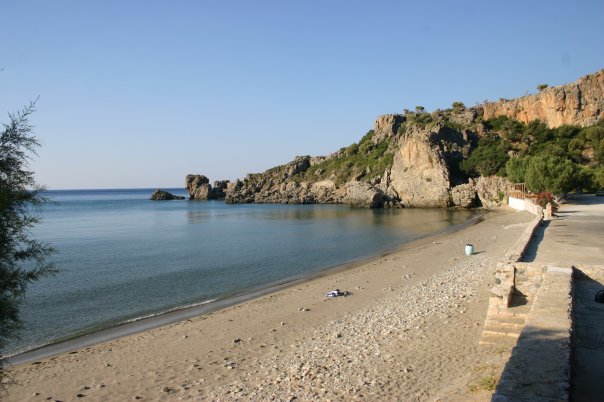
Korakas beach
Agia Galini:This resort is situated 58km south of Rethymno. Apart from the plentiful tourist infrastructure the village also boasts beautiful and clean beaches, which are situated in various picturesque inlets in the area.
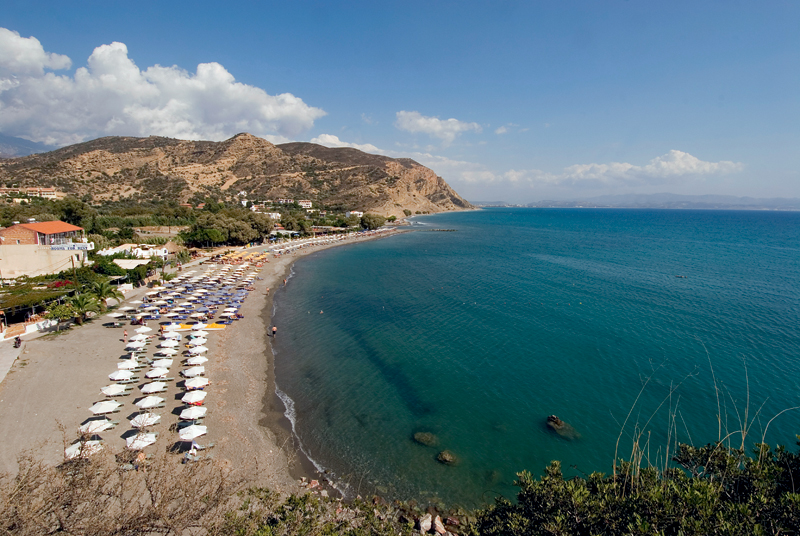
Agia Galini
Shinaria: Shinaria is located 33 km south of Rethymnon and 3 km south of the village Lefkogia, in the east part of the wider Plakias area. Shinaria is a small beach with soft-grey with crystal blue deep water. The beach is slightly organized, with the tavern offering a few umbrellas and refreshments. Follow the road from Rethymnon to Plakias and when you meet the taverns "Stelios" and "Vasilis" turn left. There are also signs showing you the way. The road that starts from Lefkogia leads to the beach after 2 km.
.JPG)
Shinaria beach
Rethymnon is characterized by a variety of contrasts. Flourishing valleys succeed harsh, mountainous areas and imposing, rocky shores, follow endless sandy beaches. Each area has its own distinct kind of beauty. Apart from the gorges and caves, here are a few areas of particular natural beauty, which we are certain the visitor will enjoy.
The Nida Plateau: 79 km from Rethymnon is the well-known Nida Plateau situated on mountain psiloritis. Not far from there you will find the Ideon Andron, the cave in which Zeus was housed as a child. On the Nida Plataeu, which is used for pasturing during the summer months yoy will find the famous “mitata” vaulted stone buildings, in which the shepherds live. Moreover the Nida Plateau provides skiing facilities during the winter months.
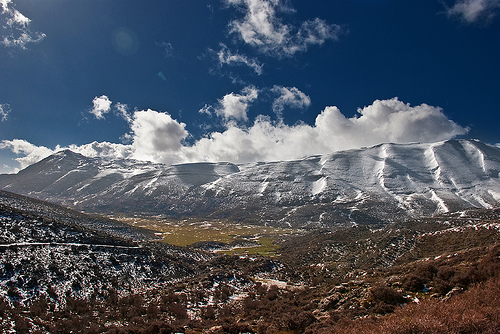
The Nida Plateau
Argyroupoli: Following the old national road from Rethymnon in the direction of Chania, after 27 km you arrive at Argyroupoli. The village has been built on the the remains of the ancient city of Lappas. The large number of springs in the place of Aghia Dynami as well as the chapel of the same name is worth visiting.
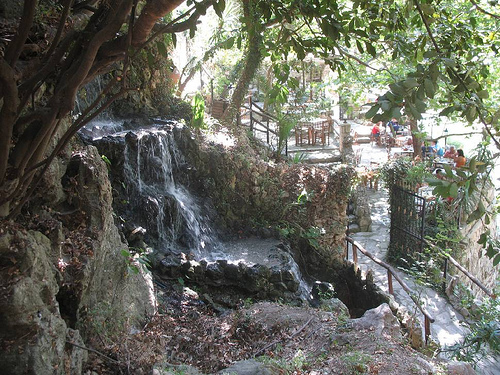
Argyroupolis
The mountains of the Rethymno prefecture are exceptionally rich in caves, there being some 850 in all. Many of these caves are of particular interest archaeologically, historically, folkloric or even just of natural beauty. The most famous caves of the prefecture are those of Gerani, of Simonelli, west of the town of Rethymno, of Aghios Antonios near the village of Patsos in the district of Amari, of Melidoni, as well as the cave of Ideon Andron, of Moungri Sison, of Sfendoni near the village of Zoniana and others.
Ideon Andron:
It is situated on the Nida plateau of Mount Psiloritis, 24 km from the village of Anoghia and 78 km from the town of Rethymno. Initially its extraordinary large entrance impresses visitors to the Ideon Andron, which is at a height of 1538 m. The cave itself is of particularly large dimensions, with a vast central hall and a gallery of 22 m in length. The cave, in which Zeus was raised according to mythology, represented an important place of worship in both the Minoan and the Roman period. The excavation works that were carried out in the interior of the cave revealed an abundance of important finds such as ceramics, gold jewellery, metal objects and of course the famous bronze shields. Since research is still in progress the cave cannot be visited.
Melidoni Cave:
Excavation works, which continue to be effected in the cave of Melidoni, have proved that the cave was used as a central place of worship from the early Neolithic age up until the Roman period. An inscription gives evidence of the fact that Hermes was worshipped in this cave. It also played an important role during modern times, more precisely during the Turkish occupation. In January 1834, the Turks besieged the cave, where 370 inhabitants of the village of Melidoni had found shelter, set it on fire and suffocated everybody in it. Their bones are preserved in the memorial sarcophagus situated in the first hall. The cave is open to visitors.
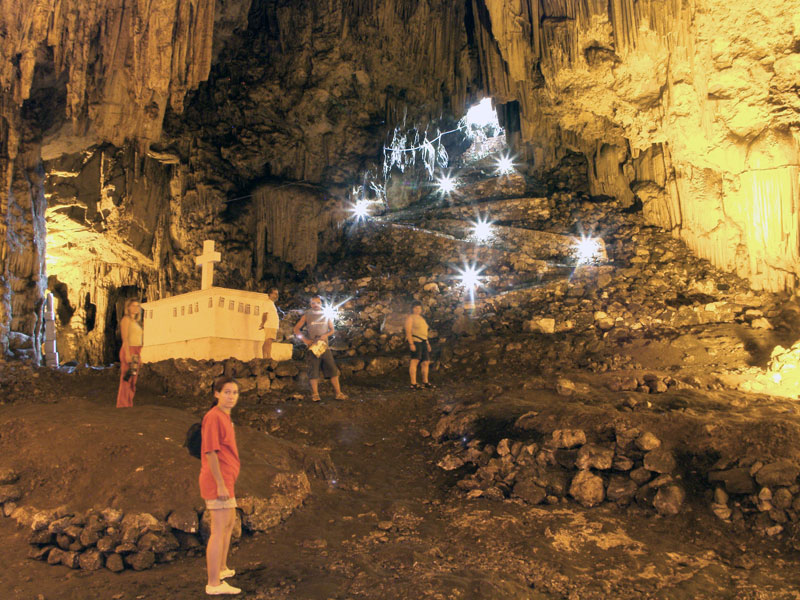
The cave of Melidoni
Gerani Cave:
This cave displays magnificent stalagmites and boasts 6 halls. Apart from three human skeletons archaeological research has brought to light a variety of bone and stone tools dating back to the Neolithic period. Furthermore important material of palaeontological interest was found, probably relics of more than 100 endemic deer, which must have died towards the end of the Pleistocene period. The human skeletons belonged to people who were probably trapped in the cave, perhaps due to an earthquake.
Sfendoni Cave:
The cave of Sfendoni is near the village of Zoniana in the district of Mylopotamos (47 km from Rethymno in the direction of Perama - Axos) displays 14 halls, richly ornamented with stalactites and stalagmites. It is 550 m long and covers a total of 3,330 sq.m. During recent years archaeological research has uncovered installations dating back to the Neolithic period in the interior of the cave.
Aghios Antonios Cave:
The Aghios Antonios cave is near the village of Patsos also represents a place of dedication as has been proved by archaeological research. It was used as an important centre of worship from the Late Minoan up until the Roman period. An inscription that was found in the cave testifies that Hermes Kraneos was worshipped here. The church in the interior of the cave is dedicated to Aghios Antonios, the patron of the children. The cave is open to visitors.
Gorges of extraordinary beauty traverse the mountains and mountain ranges of the prefecture: the ravine of Kourtaliotis which is 3 km long end at the famous Lagoon of Preveli; the ravine of Kotsifou which starts at the village of Kannevos and ends nearthe village of Sellia; the gorge of Patsos, in the Amari distinct; the gorge of Prasses, which ends at the village of Platanias at the north coast east of the town of Rethymnon; the gorge of Arkadi and a number of smaller ones.
The gorge of Kourtaliotis with its imposing precipices reaching to a height of 600 m starts shortly after the village of Koxare and ends at the Lagoon of Preveli. This magnificent gorge is worth visiting. Approximately half way through the gorge and on the left-hand- side of the road of Koxare to Asomatos are steps, which lead down to the bottom of the gorge and to the chapel of Aghios Nikolaos. The river Megalos Potamos runs through the gorge, which at this point is called river Kourtaliotis.
The gorge of Kotsifou begins at the village of Kannevos and ends at the village of Plakias. Just 10 m wide at the entrance, the beginning of the gorge is very narrow, however eventually, the gorge wide out to 600 m. It is 1,800 m long in total and its almost perpendicular walls reach a height of 600 m. A small chapel built into a rocky cavity is situated in the gorge.
The gorge of Patsos is easy to walk through. Both the gorge and the cave, which hosts the church of Aghios Antonios, have been improved by the forest authority and are an excellent destination for short tours and a picnic.
The gorge of Arkadi starts at the Arkadi Monastery and leads you through a magnificent landscape to the village of Pikri, which boasts important elements of Venetian architecture.
The Prassano gorge, which starts south of the village of Prasses offers you a three hours walk. It is impressive rock faces and a few other difficult points of access make this tour particularly interesting.
The European path E4 beginning at Gibraltar crosses Spain, France Switzerland, Germany Austria, Hungary and Bulgaria and ends up in the south-eastern edge of the Mediterranean Greece, finishing its journey at the island of Venus, Cyprus. In Greece, the Hellenic Mountaineering Association has been appointed by the European Ramblers Association, its coordinative body, to define and the path. Today the Hellenic federation of Mountaineering and Climbing is its administrative body. In the route that lies furthest in the south of Greece, the E4 crosses Crete, beginning at Elafonisi, on the west coast and ending up at Kato Zagkros , on the east coast. In this route, the path often branches off, so that hikers have the chance to choose among routes of variable natural and cultural beauty. In the prefecture of Rethymnon the E4 path also comprises two branches, the northern one and the southern one. The northern branch comes into the administrative borders of the prefecture from the region of Argiroupoli village and the northern one from the region of Rodakino. The two branches meet at the plateau of Nida on the mountainous mass of Psiloreitis and, from there, the path goes on to the administrative borders of the prefecture of Heraklion. The two branches of the prefecture of Rethymnon cross areas of great natural beauty and lands of important geological, archaeological, historical, and generally natural value. They also offer the chance to go hiking in the mountains of Krioneritis, Kedros and Psiloreitis. Especially, mountain Kedros and south-western part of the mountain range of Psoloreitis belong to the Natura 2000 European network, in which Kouraliotiko gorge, which is close to the E4 path, is also included. The southern branch is recommended to hikers in good form and to those, whose interests focus on Byzantine era. The northern part is recommended to hikers that are more interested in the Venetian occupation and modern culture.
The official site of the prefecture of Rethymnon offers a detailed guide of the path. This guide includes a general description of the path in the prefecture of Rethymnon and it intends to facilitate people who wish to cross it as a whole or a part. It focuses on points of high interest, whether those are located on the route or at a close distance from it. Prospective hikers should be very careful concerning the marks of the E4, since at some points those marks are unnoticeable and/or damaged. In any case, hikers must consult the Useful Guidelines given at the end in advance, in order to be able to enjoy the beauties of the prefecture of Rethymnon without being distracted.
There is the link for the guide: E4_European_path
Useful Telephones
| Code | +30 |
| Tourism Promotion Committee of Rethymnon Prefecture | 28310 25571,2 Fax: 25064 |
| Municipality of Rethymnon | 28310 41301-5 |
| Greek National Tourism Organization (GNTO) | 28310 29148, 56350 |
| Police | 100 |
| Tourist Police | 28310 53450, 28156 |
| Traffic Police | 28310 22589 |
| Police Station | 28310 88154 |
| Fire Brigade | 199 |
| Port Authorithy | 28310 22276 |
| Post Office | 28310 22303 |
| Hospital | 28310 87100 |
| Dialisys Center (1) Hospital | 28310 26093 |
| Dialisys Center (2) General Clinic "Asklipios" | 28310 24524-6 |
| Spili Health Center | 28320 22222 |
| Anogia Health Center | 28340 31208 |
| Perama Health Center | 28340 23075 |
| Agia Fotini Health Center | 28330 22750-2 |
| Public Bus Station | 28310 22212 |
| Taxi | 28310 25000, 71900, 22316 |
| TAXI for Handicapped Persons (G. Lagouvardos) | 6947 602827, 28310 56678 |
| Hotel Association of Rethymnon | 28310 55873 |
| Hotel Association of South Coast | 28320 31280-2 |
| Rent Rooms Association "Filoxenia" (Plakias) | 28320 31152 |
| Rent Rooms Association "Xenios Zeus" | 28310 29503 |
| Pan-Cretan Cooperative of Alternative Tourism | 28340 61818, 61611 |
| Mountaineering Club | 28310 57766 |
| Sailing Club | 28310 50450 |
| Cycling Club | 28310 53197 |
| Archaeological Museum of Rethymno | 28310 54668 |
| Municipal Gallery "L. Kanakakis" | 28310 52530, 52689 |
| Historical and Folklore Museum of Rethymno | 28310 23398 |
| Cretan Popular Art Center | 28310 51501 |
| Paleontological Museum of Rethymnon | 28310 23083 |
| Catholic Church | 28310 26416 |
| Folklore Museum of History (Somatas) | 28310 41315 |
| Greek Traditional Costumes Museum (Roustika) | 210 7661949, 6932750946 |
| Monastery of Preveli | 28320 41444 |
| Monastery of Arkadi> | 28310 83076, 83126 |
| Cave of Zoniana | 28340 61734 |
| Church Museum | 28310 22731 |
| The Museum of "Monastery of Arkadi" | 28310 83076, 28310 83135 |
| The Museum of "Monastery of Preveli" | 28320 41 444 |
| Military Museum, Chromonastiri | 28310 75 135 |
| Woodcarving workshop & showroom, Axos Mylopotamos | 6937691387 |
| Wax Museum “Potamianos” | 28340 61087, Fax: 28340 61827 |
| Museum of the Olive, Kapsaliana | 28310 83400, Fax: 2831083383 |
| The mill of Prinari, Chromonastiri | 210 9944757, FAX 210 9916339, Mob: 6977416305 |
| Papageorgoulakeio Folk Museum, Asomatos | 28320 31674 |
| Spiritual - Cultural Center Anestis and Manolis Anagnostakis | 6977589932 |
| The house of “Polios” | 6979495098, 6974412534 |
| Museum of Traditional Greek Costumes “Kate & Andreas Fragkiadaki” | 210 7661949, 6932750946
|